
The Loneliest Seat in the Revenue Organization
· 4 min read
 Davy Nys · GTM Advisory
There's something about being a CRO that people rarely talk about.
It can be an incredibly lonely job.
Not because you're physically alone. Quite the opposite. You're surrounded by your sales team, your peers, the CEO, and the board. Everyone wants something: better forecasts, more pipeline, higher conversion rates, shorter cycles, more predictable revenue.
Preferably before the end of this quarter.
But who do you turn to when you're the one who needs help?
You can't always share every concern with your team; they look to you for direction and confidence. You can't always share every doubt with your CEO, particularly when the founder is part of the problem you need to address.
And you're still accountable for the number.
Building the parachute on the way down
I've spent more than twenty years in sales and revenue leadership. In a startup or scale-up, it can feel like jumping out of an airplane without a parachute.
You're building the parachute while falling.
You must deliver today's revenue. This month's target. This quarter's forecast.
At the same time, you're supposed to revisit the ICP, improve pipeline generation, develop your team, align Marketing, challenge Product, improve conversion, and build a scalable revenue organization.
You often know what needs fixing. You know you should examine why some demos convert and others don't. You know you should revisit your assumptions about customers. You know there are gaps in the revenue engine.
But knowing what deserves attention and finding the headspace to address it systematically are two very different things.
Experience doesn't eliminate blind spots
Experienced leaders know their routes. They recognize patterns and understand what healthy revenue operations look like.
Until circumstances change. The economy turns, a product underperforms, a team becomes unstable, or buyers behave differently.
Like the drive home when a road unexpectedly closes, suddenly you could use a GPS.
Not because you've forgotten how to drive. Because it helps you see alternatives and navigate change.
Product-market fit isn't a destination. Go-to-market fit isn't a box you tick. They're journeys. The scenery keeps changing.
We don't need AI to think for us
There's an entire industry promising AI agents that run outbound, write emails, and automate the whole go-to-market motion.
I'm skeptical that ever more automated outreach is what sales needs. If every company sends more messages, buyers will increasingly tune out or block the noise.
The role I find much more interesting for AI is to challenge a leader's assumptions.
Ask the uncomfortable question. Surface the blind spot. Help distinguish evidence from an opinion we've held for years.
Not outsource strategic thinking.
Force strategic thinking, with scaffolding to support it.
Why I built GTM Advisory
Across companies, founders, and difficult revenue situations, I often wished I had a comprehensive framework to fall back on.
A way to examine the organization without rebuilding the structure of the exercise from scratch.
A playbook for building my own playbook.
Not a universal methodology. Not a consultant with a slide deck listing things I already know I should do.
Something practical: questions, assessments, and building blocks that cover the many dimensions of revenue.
Something I can work through at my own pace.
Focus a week on pipeline generation. Then work on customer success. Or tackle a maturity level across all chapters. Add business-specific requirements that don't fit a generic framework.
That's how GTM Advisory took shape: nine revenue chapters, Chapter 0 for pre-revenue businesses, and more than 200 components across foundational, growth, scale, and optimized maturity.
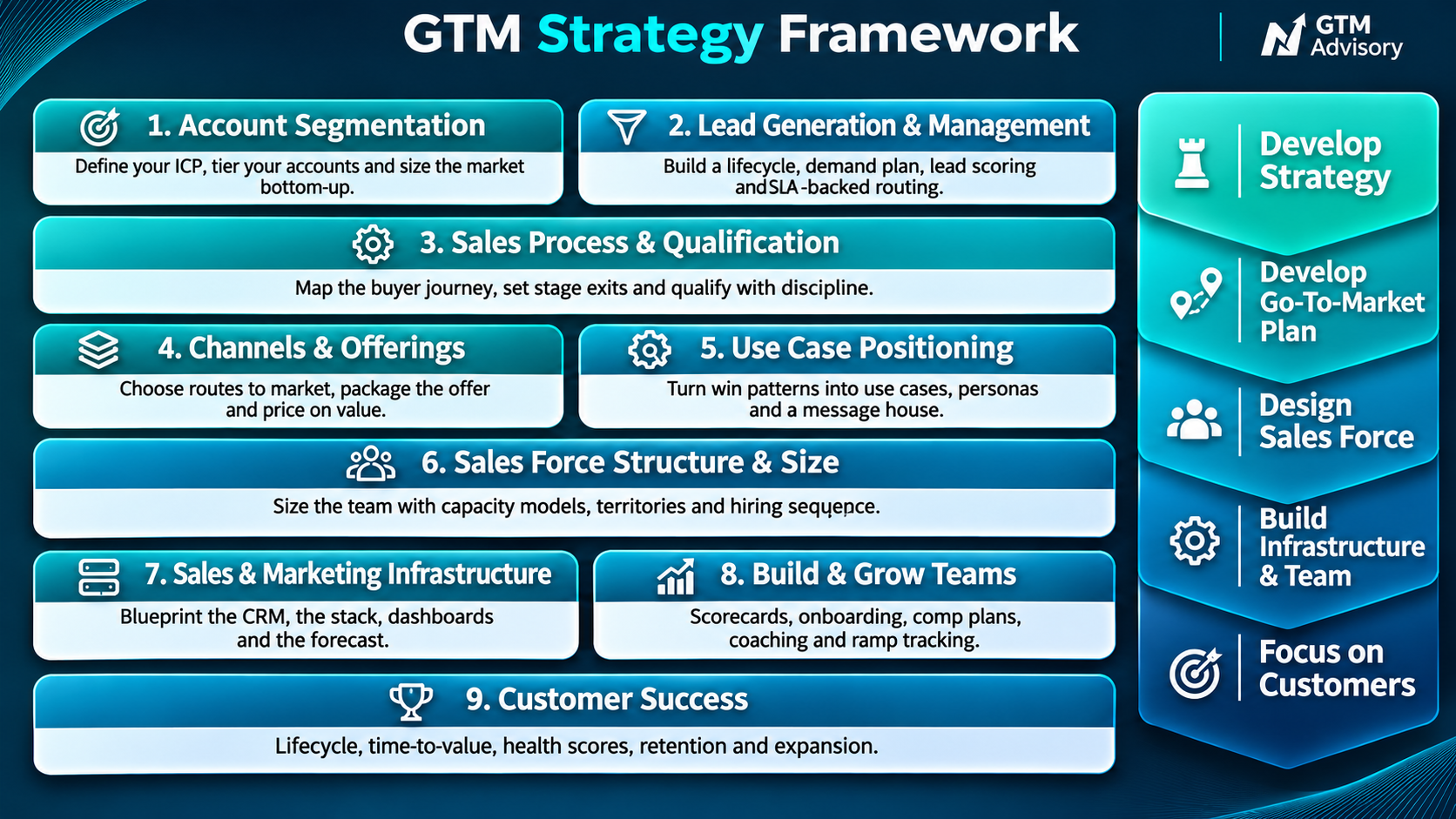
You can do it independently or bring in coaching, consulting, and board advisory when you need another perspective.
The framework isn't the answer. It's the structure that helps you find better answers.
You don't have to carry everything alone
Being accountable doesn't mean you have to solve every problem without support. Being experienced doesn't mean you always have the answers.
Sometimes your most valuable work is to create space for questions you've been too busy to ask.
Are we targeting the right customers? Do we understand why they buy? Where are we underperforming? Are we fixing symptoms or causes? Is the whole business aligned around the same definitions?
I know how it feels to understand what's broken but not have the runway—or sometimes the founder's support—to fix it.
That's ultimately why I started GTM Advisory.
You still have to drive. You still have to decide. You still own the number. But you shouldn't have to build the GPS at the same time.